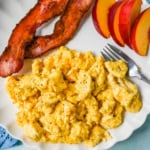
Cottage Cheese Scrambled Eggs
These Cottage Cheese Scrambled Eggs are the creamiest, fluffiest scrambled eggs you'll ever make — with over 20g of protein per serving! Learn the simple technique, the best mix-ins, and every tip for perfect scrambled eggs every time.
Servings: 3
Ingredients
- 6 large Eggs
- 1/2 cup Cottage Cheese
- 1/4 teaspoon Salt (plus more to taste)
- 1/4 teaspoon Pepper
- 1/4 cup Cheddar or Parmesan Cheese (grated)
- Butter or Non-Stick Cooking Spray
Instructions
- Option A: Whisk it in as-is. Add the cottage cheese directly to your mixing bowl with the eggs and whisk together — you'll still see small curds throughout the cooked eggs for extra texture.Option B: Blend it smooth. Add the eggs to a blender or a tall container if using an immersion blender, then add the cottage cheese and blend until completely smooth, about 15–20 seconds. This gives you a fully uniform, custard-like texture with no visible curds.
- If you used Option A, whisk the eggs and cottage cheese together until fully combined with no streaks. If you used Option B, your mixture is already blended — just pour it into a bowl. Either way, stir in a pinch of salt and pepper at this stage. Adding salt to the eggs before they hit the pan (rather than after) gives it time to dissolve and season the eggs evenly, and many cooks find it also helps keep the eggs more tender.
- Use low to medium-low heat. This is the single biggest factor in whether your eggs turn out creamy or rubbery. High heat cooks the outside of the eggs too quickly, leading to tough, dry curds. Low and slow gives you soft, custardy eggs. Add butter to pan or spray with non-stick cooking spray. Pour in egg mixture.
- Don't walk away. Scrambled eggs go from perfect to overcooked in the span of about 30 seconds. Stay at the stove and keep your eyes on the pan the entire time.
- Push, don't stir constantly. Rather than continuously stirring, use a spatula to gently push the eggs from the edges of the pan toward the center as they begin to set, letting the uncooked egg flow into the space you've cleared. This creates soft, large curds instead of small, tight, scrambled bits.
- Add cheese near the end of cooking, once the eggs have mostly set but are still soft and slightly glossy. Adding it too early means the cheese can either fully melt into the eggs and disappear (fine if that's the texture you want) or cause the eggs to stick and cook unevenly as the cheese affects the pan's surface.
- Pull them off the heat early. Eggs continue cooking from residual heat even after you take the pan off the stove. Remove them while they still look slightly underdone and glossy — they'll finish setting on the way to the plate. Taste and add more salt or pepper, if desired.
- Let them rest for a few seconds before serving. This gives the residual heat time to finish the eggs gently without overcooking them directly in the pan.
Notes
What mix-ins to add to eggs? Try cooked crumbled bacon, diced peppers, sauteed mushrooms, cheddar, breakfast sausage, green chilies, jalapenos, diced tomatoes, spinach, parmesan cheese, green onions or chives, chicken sausage, diced ham, shredded mozzarella.
Nutrition
Calories: 209kcal | Carbohydrates: 4g | Protein: 19g | Fat: 13g | Saturated Fat: 5g | Polyunsaturated Fat: 2g | Monounsaturated Fat: 4g | Trans Fat: 0.04g | Cholesterol: 384mg | Sodium: 538mg | Potassium: 199mg | Fiber: 0.04g | Sugar: 1g | Vitamin A: 638IU | Calcium: 156mg | Iron: 2mg
